Call It Early, Call It Loud: Scorekeeping That Survives Coylton Doubles
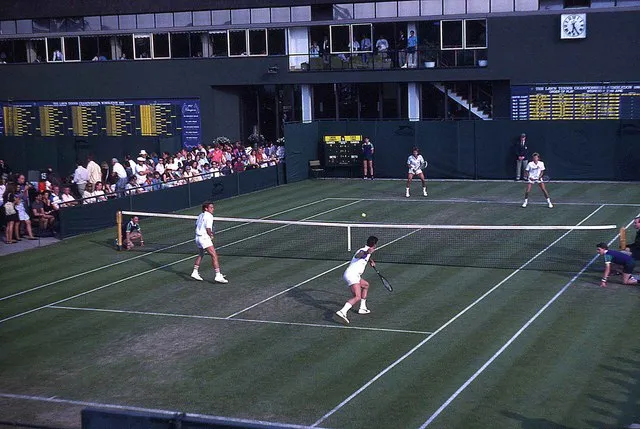
Photo: Barry Shimmon, CC BY-SA 2.0, via Wikimedia Commons
There's a particular kind of silence on a tennis court that has nothing to do with concentration. It arrives roughly seven points into a tight set, when four people are standing in approximately the right positions and absolutely nobody knows whether it's 30-30 or deuce. Somebody says "was that...?" and somebody else says "I thought you were..." and the whole thing sags.
Good news: it's fixable. It doesn't need a rulebook, an umpire's chair or a personality transplant. It needs about three seconds of habit per point, and a bit of good humour when the wheels inevitably come off.
The score is a sentence, not a secret
Scorekeeping goes wrong at club level for a very human reason: we treat the score as something we'll remember, when actually it's something we should say. Memory is a poor filing system at the best of times, and a tennis point is followed immediately by a ball to fetch, a partner to nod at, and someone on the next court asking whether you've got a spare can opener in that bag.
So the first principle is simple. The score gets spoken, out loud, before the ball is bounced for the next serve. Not muttered. Not thought. Said, loudly enough for the back court, loudly enough for your partner. Loud enough that the words exist in the air rather than only in your head.
It sounds almost too obvious written down. It's remarkable how often it isn't done.
The server owns the number
Here's the bit that quietly solves most disputes: the server calls the score, and the server says their own score first.
That's the whole convention. 30-15 means the serving pair has thirty. 15-40 means they're staring down two break points and should probably take a breath. Because the order is fixed, nobody has to remember who's ahead — they just have to remember to say it the right way round.
This is a small thing that prevents a very specific argument, the one where two perfectly reasonable adults realise they've been playing the same game from opposite assumptions for ten minutes. The server's voice settles it before it starts.
If you're returning, listen for that call. If it doesn't come — and it won't always, especially in a tight game — it's fine to ask. "What have you got?" isn't an accusation. It's housekeeping.
Three habits that carry the weight
Beyond the out-loud rule, a few small routines make the numbers stick.
Say it at the changeover, not just the point. Every odd game, as you walk to the other end, add the set score to the sentence. "Three-two, we're up." Six extra seconds, and it anchors both the games and the set in everyone's head.
Use the space around you. The scoreboard by the fence exists for a reason, and there's no shame in flipping the numbers. If the board is taken, a small card in a pocket or a note on your phone between games does the job. Nobody ever lost a match by being the person who wrote it down.
Reset with a physical cue. A tap of the racket on your shoe, two bounces before the first serve, a glance at your partner. Pick one and repeat it every point. The cue isn't magic — it's just a door handle that reminds your brain to say the score on the way through.
Deuce, advantage and the wobble in between
Deuce is where scorekeeping goes to die, mostly because the numbers stop being numbers and start being a mood.
Keep it short at deuce. "Deuce." Then "advantage in" or "advantage out" — or "ad us", or simply "advantage, us" if the in/out convention gets tangled. What matters is that everyone knows whether the next point wins the game or drags it back to square one.
And if the advantage goes? Don't drift. Say "back to deuce" clearly, even if the point was scrappy, even if there was a net cord and a bit of a discussion about it. Clarity after a messy point is worth more than clarity after a clean one.
One more for social doubles: the score is only half the story — who's serving is the other half. A quick "yours, then mine" at the start of a game removes any chance of a confused rally where both pairs think they're receiving.
When nobody is sure — the friendly reset
It will happen. The ball will be in the fence, a dog from the next court will be making a bid for freedom, and someone will say the words that strike fear into any club player: "Hang on, what is it?"
Here's the Coylton-approved response: work backwards, not forwards. Start from the last point or game that everyone genuinely agrees on, and count from there. If the disagreement runs deeper, replay the game from a score you both accept. Nobody's ranking points are at stake. A replay isn't a defeat, and it's certainly better than twenty minutes of polite standoff.
Good humour helps. A quick "right, we're going with deuce, and if it turns out it was 40-15 we'll call it a moral victory" usually does the trick.
Juniors, short sets and the odd tie-break
Junior sessions bring their own quirks. Mini Tennis matches often use short sets — sometimes first to four games — and the scoring can be first to seven points in a tie-break with no advantage. It isn't complicated, but it is different, so it's worth a thirty-second chat before the first ball.
The best thing you can do for a young player learning to score is to let them call it. Let them get it wrong. Let them correct themselves. A junior who has called their own score for a season will walk into a match far more confidently than one who has had an adult do it for them.
Same goes for tie-breaks, where the numbers change every single point. That's exactly why the out-loud habit matters most there: say it before each serve, add the set score at the change of ends, and don't be shy about writing it down.
The habit, not the memory
Keeping score isn't a test of memory. It's a small act of communication, repeated often, shared between four people who would all rather be playing than debating.
Say it clearly. Say it before the serve. Write it down when it's tight. And if the wheels come off, work backwards with a smile.
Then get on with the tennis — that's what everyone turned up for.